Why Your 'Smart' Decisions Keep Feeling Wrong (And What to Do About It)"
Smart students often doubt their best decisions. New psychology research reveals why good choices feel wrong—and how to work with your doubt instead of against it.

A reflection on the hidden psychology behind decision reversals and why our smartest choices sometimes feel the most wrong
The 3 AM Question
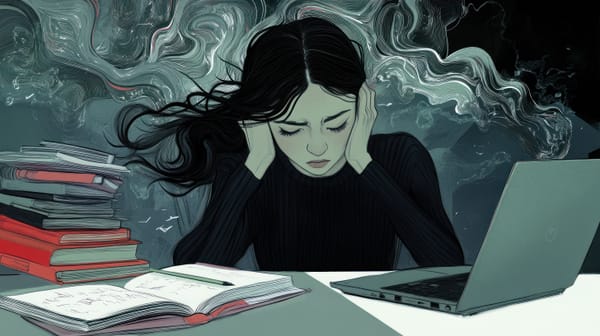
Maya stares at her laptop screen, the acceptance email glowing in the darkness of her dorm room. Six months ago, she'd carefully researched graduate programs, weighed her options, consulted mentors, and made what everyone—including herself—agreed was a smart choice. The program was prestigious, well-funded, and aligned perfectly with her career goals.
So why, at 3 AM on a Tuesday, was she googling "how to decline a graduate school acceptance you already committed to"?
If you've ever felt this way—confident in a decision one day, completely doubtful the next—you're not alone. And more importantly, you're not irrational. What Maya was experiencing is one of the most common yet misunderstood aspects of human decision-making: the psychological aftermath of choice.
When Logic Meets Life
Here's what we rarely talk about in academic settings: making a "good" decision and feeling good about a decision are two entirely different psychological processes. Maya's choice was objectively sound—backed by data, aligned with her stated goals, supported by trusted advisors. But choices don't exist in a vacuum. They live in the messy, complicated landscape of our inner world, where identity, emotion, and uncertainty wage daily battles.
The research reveals four specific psychological mechanisms driving this phenomenon:
Cognitive dissonance - the brain's alarm system for internal conflict: Leon Festinger's landmark research shows that when our choices conflict with our self-concept, the anterior cingulate cortex literally fires distress signals. Maya's program was objectively good, but her brain was detecting a mismatch between "I am someone who values creativity and flexibility" and "I have chosen a rigid, traditional path." This neurological discomfort isn't weakness—it's your mind protecting your authentic self.
Post-decisional emotional flooding: Antonio Damasio's research on "somatic markers" reveals that our bodies generate emotional wisdom about decisions—sometimes days or weeks after we make them. That queasy feeling Maya had wasn't random anxiety; it was her emotional system updating her on information her logical mind had missed. Studies show that people who ignore these bodily signals make worse long-term decisions, even when their initial logic was sound.
Loss aversion amplifying uncertainty: Daniel Kahneman's Nobel Prize-winning research demonstrates that we feel losses twice as intensely as equivalent gains. As Maya's start date approached, her brain began cataloging everything she'd lose—freedom, other opportunities, her current identity. This isn't catastrophizing; it's an evolved survival mechanism that helped our ancestors avoid dangerous irreversible choices.
Decision fatigue depleting willpower: Roy Baumeister's studies using glucose monitoring show that decision-making literally burns mental energy. After months of graduate school decisions, Maya's prefrontal cortex—responsible for rational thinking—was running on empty. In this depleted state, the emotional brain takes over, making reversal feel like the only way to reduce cognitive load.
The Difference Between Productive and Destructive Doubt
Not all second-guessing serves the same purpose. Neuroscience research distinguishes between two types of post-decision doubt:
Adaptive re-evaluation occurs when new information genuinely challenges your choice. Brain imaging shows increased activity in the prefrontal cortex—your rational thinking center—as it processes relevant updates. This is your mind doing exactly what it should: incorporating new data.
Maladaptive rumination happens when you replay the same scenarios without new information, creating what researchers call "counterfactual loops." Studies show this activates the brain's default mode network excessively, leading to decreased satisfaction regardless of the decision's actual quality.
Productive second-guessing asks:
- "What new information am I learning about myself or this situation?"
- "Is this discomfort about genuine misalignment, or natural transition anxiety?"
- "What specific evidence would increase my confidence in this choice?"
Destructive rumination spirals with:
- "I always make terrible decisions"
- "Everyone else seems so sure about their choices"
- "What if I've ruined my entire future?"
The neurological difference matters: adaptive re-evaluation strengthens your decision-making capacity over time, while rumination actually weakens it by reinforcing neural pathways associated with doubt and regret.
What Maya Learned (And What We Can Too)
Three weeks after her 3 AM crisis, Maya made a choice that surprised everyone, including herself. She didn't withdraw from the program, but she also didn't stop questioning. Instead, she got curious about her doubt.
She realized that her fear wasn't really about the program—it was about leaving behind a version of herself that felt safe and known. The choice was sound, but the transition was scary. This distinction changed everything.
Maya developed what she called her "uncertainty practice": instead of trying to eliminate doubt, she learned to sit with it, to ask what it was teaching her, and to distinguish between the fear of making the wrong choice and the natural discomfort of growth.
Reframing the Narrative
What if we stopped viewing second-guessing as a sign of weakness or poor decision-making, and started seeing it as evidence of a thoughtful mind grappling with complex realities?
What if we normalized the fact that good decisions often feel uncomfortable, especially in the beginning?
What if we taught students that confidence isn't the absence of doubt, but the ability to move forward despite it?
The goal isn't to make perfect decisions—it's to make authentic ones and then learn to live with the complexity they bring. Maya's story isn't about finding the "right" choice; it's about learning to trust herself through the inevitable turbulence that follows any meaningful decision.
Your Decision Resilience Toolkit: Three Evidence-Based Practices
The goal isn't to eliminate doubt—it's to work with it intelligently. Here's what the research shows actually works:
1. The 48-Hour Rule (Based on Emotional Regulation Research)
When doubt hits hard, commit to waiting 48 hours before taking action. Neuroscientist Lisa Feldman Barrett's research shows that intense emotions naturally regulate within this timeframe, allowing your prefrontal cortex to come back online. During this pause, practice the "name it to tame it" technique—simply labeling your emotions ("I notice I'm feeling anxious about uncertainty") reduces amygdala activation by up to 50%.
2. Values Alignment Check (Rooted in Self-Determination Theory)
Create a simple two-column list: your top 5 core values in one column, specific ways your decision honors each value in the other. Research by psychologists Edward Deci and Richard Ryan shows that choices aligned with intrinsic values create lasting satisfaction, even when they involve short-term discomfort. If you can't find connections, that's valuable data—not about the decision's quality, but about the need for either reframing or genuine reconsideration.
3. The Uncertainty Practice (From Acceptance and Commitment Therapy)
Instead of asking "Am I making the right choice?" ask "Am I making this choice for the right reasons?" Research by Steven Hayes shows that people who can tolerate uncertainty while staying connected to their values make more satisfying long-term decisions. Practice sitting with "not knowing" for short periods—5 minutes daily—to build your uncertainty tolerance muscle.
The Bottom Line: What You Can Trust
Here's what Maya learned, and what you can take with you:
Trust this: Your doubt often contains wisdom. When your gut feels uneasy, pay attention—but investigate, don't just react.
Trust this: Smart people change their minds. Flexibility isn't failure; it's intelligence responding to new information.
Trust this: Discomfort doesn't disqualify a decision. Growth and uncertainty are inseparable companions.
Don't trust this: The voice that says you should "just know" what's right. Certainty is a feeling, not a fact, and it's often inversely related to the complexity of the choice.
Don't trust this: Comparisons to others who "seem sure." Research shows we systematically underestimate others' uncertainty and overestimate our own.
The next time you find yourself questioning a choice you felt good about in daylight, remember: this isn't evidence of poor judgment. It's evidence of a mind sophisticated enough to grapple with complexity. The question isn't whether you'll feel uncertain—the question is what you'll do with that uncertainty when it arrives.
Your doubt isn't the enemy of good decisions. When approached with curiosity rather than judgment, it's often their greatest ally.