An Experiment in Career Design: How One Student Used Psychology to Architect Her Own Happiness
Ready to start your own career design experiment? The goal isn't perfection—it's intentional action toward a more fulfilling professional life. Begin with the phase that feels most relevant to your current challenges, and remember: you are the architect of your career experience.

We spend a third of our lives at work—roughly 90,000 hours over a lifetime. It's a staggering amount of time. So why do so many of us feel like passengers, riding along a career path that doesn't feel like our own?
"I feel like I'm sleepwalking through my career," Maya told me during our first advising session. She was three years into a marketing role at a tech startup, competent but uninspired. "I keep waiting for something to click, for the work to feel meaningful. But honestly? I'm starting to wonder if this is just what adult life feels like."
Maya's story is far from unique. She was experiencing what I call "professional drift"—the unsettling sense that your career is happening to you rather than being consciously designed by you. Instead of accepting this as just another quarter-life crisis to endure, I proposed an experiment.
"What if," I asked her, "instead of waiting for fulfillment to find you, you could proactively design it?"
Drawing from career psychology research, Maya and I designed a month-long intervention. She would spend four weeks not just doing her job, but actively architecting it using evidence-based psychological principles.
The core premise we tested was both simple and revolutionary: happiness in your career is not a matter of chance, but the result of deliberate design. This involves deep self-understanding, realistic expectation-setting, and conscious choice-making.
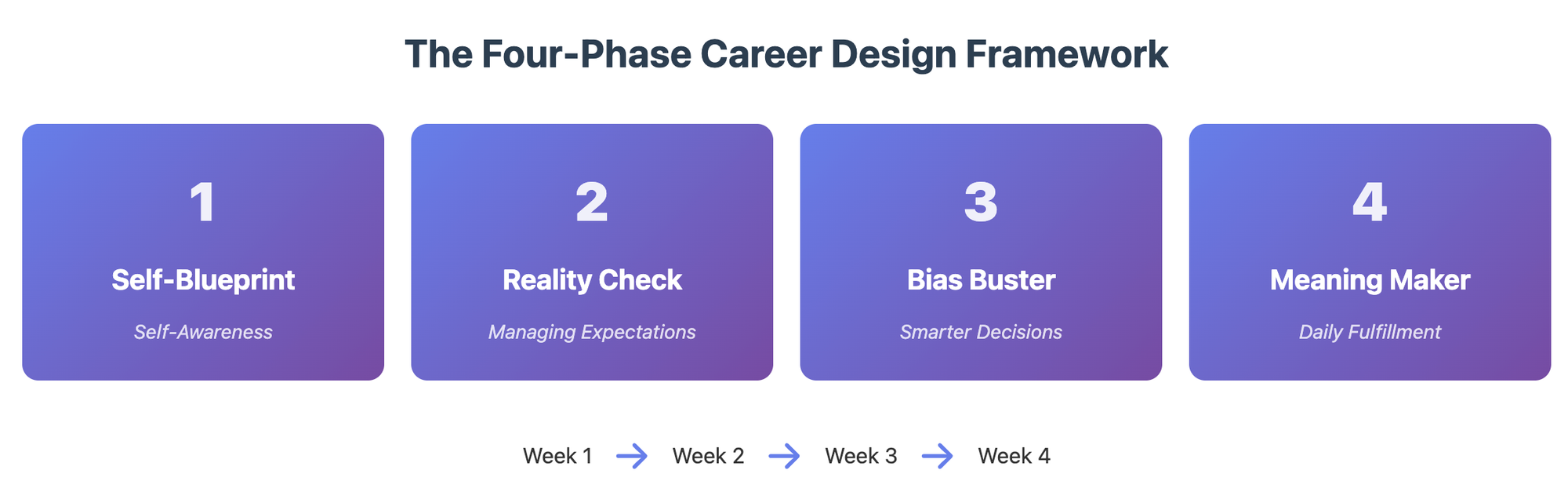
Here's the framework Maya used during her month-long experiment—a journey that transformed not just her work experience, but her entire relationship with professional growth.
Phase 1: Creating the Self-Blueprint (Week 1)
The Foundation: Self-Awareness
"I've never actually thought about what I need from work," Maya admitted. "I just assumed I should be grateful to have a job that pays well."
Before you can design anything meaningful, you need to understand what you're working with. Foundational career theories emphasize that self-awareness is the first and most critical step in creating professional satisfaction. Without knowing yourself, you're essentially building on someone else's foundation.
The Process
Maya focused on two evidence-based assessments:
1. Identifying Her Vocational Personality
Using John Holland's RIASEC model¹, Maya discovered she was strongly Investigative (analytical thinker) and Social (people-oriented), with moderate Artistic (creative) tendencies.
"This explains so much," she said after reviewing her results. "No wonder I love diving into consumer behavior data but feel drained by routine campaign execution. And why I get energized when I'm mentoring new team members."
2. Clarifying Her Core Values
Maya created a prioritized list of what truly mattered to her in work contexts—not just salary and title, but deeper drivers like intellectual challenge, collaborative relationships, and the ability to see direct impact from her efforts.
"I realized I've been optimizing for things that don't actually matter to me," she reflected. "Like impressing my manager versus actually learning something new."
The Outcome
Maya created her "Personal Blueprint"—a one-page document that clearly stated: "This is who I am professionally, and this is what I need from my work to feel fulfilled."

Maya's Blueprint included:
- Core Strengths: Data analysis, relationship-building, creative problem-solving
- Energy Sources: Complex research projects, mentoring others, and cross-functional collaboration
- Value Priorities: Continuous learning, meaningful impact, authentic relationships
- Environmental Needs: Autonomy over methods, regular feedback, variety in challenges
"Having this written down felt like putting on glasses for the first time," Maya told me. "Suddenly, everything was in focus."
Phase 2: The Reality Check (Week 2)
The Recalibration: Managing Expectations
"I think I've been setting myself up to fail," Maya said during our second check-in. "I expect every project to be perfect, every presentation to wow the room, every campaign to exceed all benchmarks. It's exhausting."
Unrealistic expectations are a primary source of career misery. They create chronic dissatisfaction, fuel imposter syndrome, and generate a persistent sense of falling short.
The Work
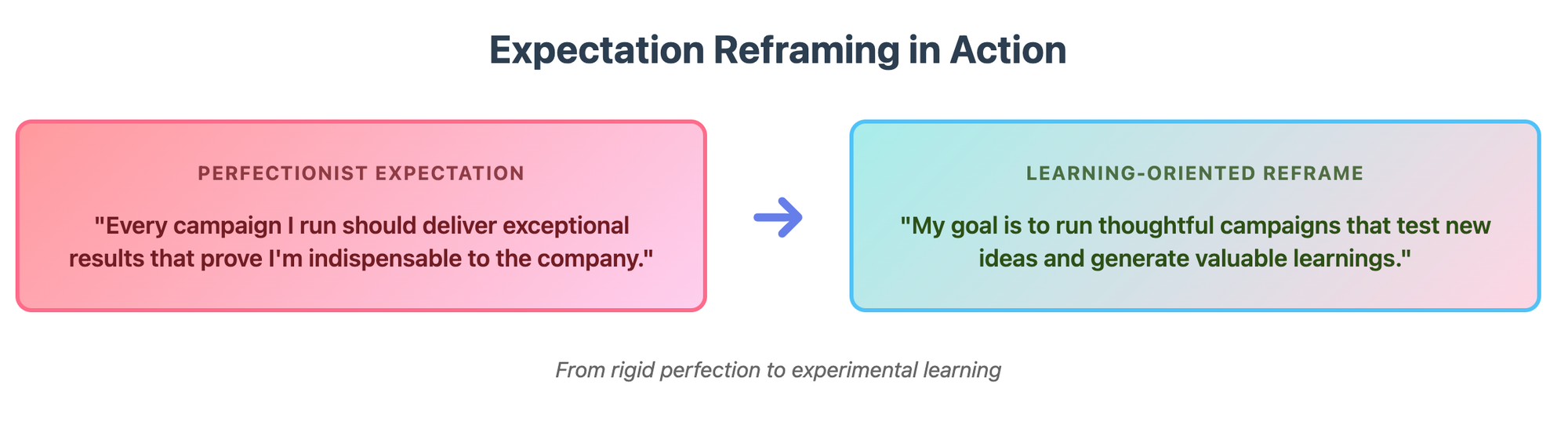
Maya identified her most toxic professional expectation: "Every campaign I run should deliver exceptional results that prove I'm indispensable to the company." This perfectionist demand was creating paralysis around taking creative risks.
Using cognitive reframing techniques², we rewrote this expectation together: "My goal is to run thoughtful campaigns that test new ideas and generate valuable learnings. Some will succeed dramatically, others will teach us what doesn't work—both outcomes are valuable."
"It sounds so obvious when you say it like that," Maya laughed. "But I've been treating every campaign failure like a personal character flaw."
The Shift
This reframe from rigid perfection to experimental learning was immediately liberating. Within the week, Maya proposed a bold campaign idea she'd been sitting on for months, framing it explicitly as a "learning experiment" rather than a "guaranteed win."
"I stopped avoiding challenging projects," she reported. "Instead of asking 'What if this fails?' I started asking 'What will we learn from this?'"
Phase 3: The Bias Buster (Week 3)
The Upgrade: Smarter Decision-Making
"I need to tell you about something that happened this week," Maya said, calling an impromptu session. "I think I've been making a huge mistake."
Our brains use mental shortcuts to navigate complex decisions, but these shortcuts can create systematic biases that derail our careers. One of the most common is the Sunk Cost Fallacy³: continuing to invest in something simply because you've already invested time or effort—even when it's no longer the best choice.
The Revelation
Maya had been spending two hours every Friday updating a comprehensive project tracking spreadsheet that no one else on her team actually used or referenced.
"I realized I was only maintaining it because I'd already spent so much time building it," she said. "I asked myself: 'If I were starting fresh today, would I create this system?' The answer was absolutely not."
The Decision
Instead of continuing with the time-consuming spreadsheet, Maya proposed a simpler project management approach that took 15 minutes instead of two hours each week.
"My manager actually thanked me for suggesting the change," Maya reported. "Apparently, she'd been wondering why I seemed so stressed about project tracking when everyone else was using the shared digital workspace just fine."
The Broader Application
"Now I catch myself asking the bias-busting question constantly," Maya told me. "'Am I choosing this because it's the best path forward, or because it's the path I've already started walking?'"
This question revolutionized how Maya approached everything from meeting attendance ("Do I need to be in this recurring meeting, or am I just going because I've always gone?") to skill development ("Am I pursuing this certification because it aligns with my blueprint, or because I've already paid for it?").
Phase 4: The Meaning Maker (Week 4)
The Design: Cultivating Daily Fulfillment
"I want to try something," Maya said during our final week. "I want to see if I can make my current role feel more aligned with my blueprint without changing jobs."
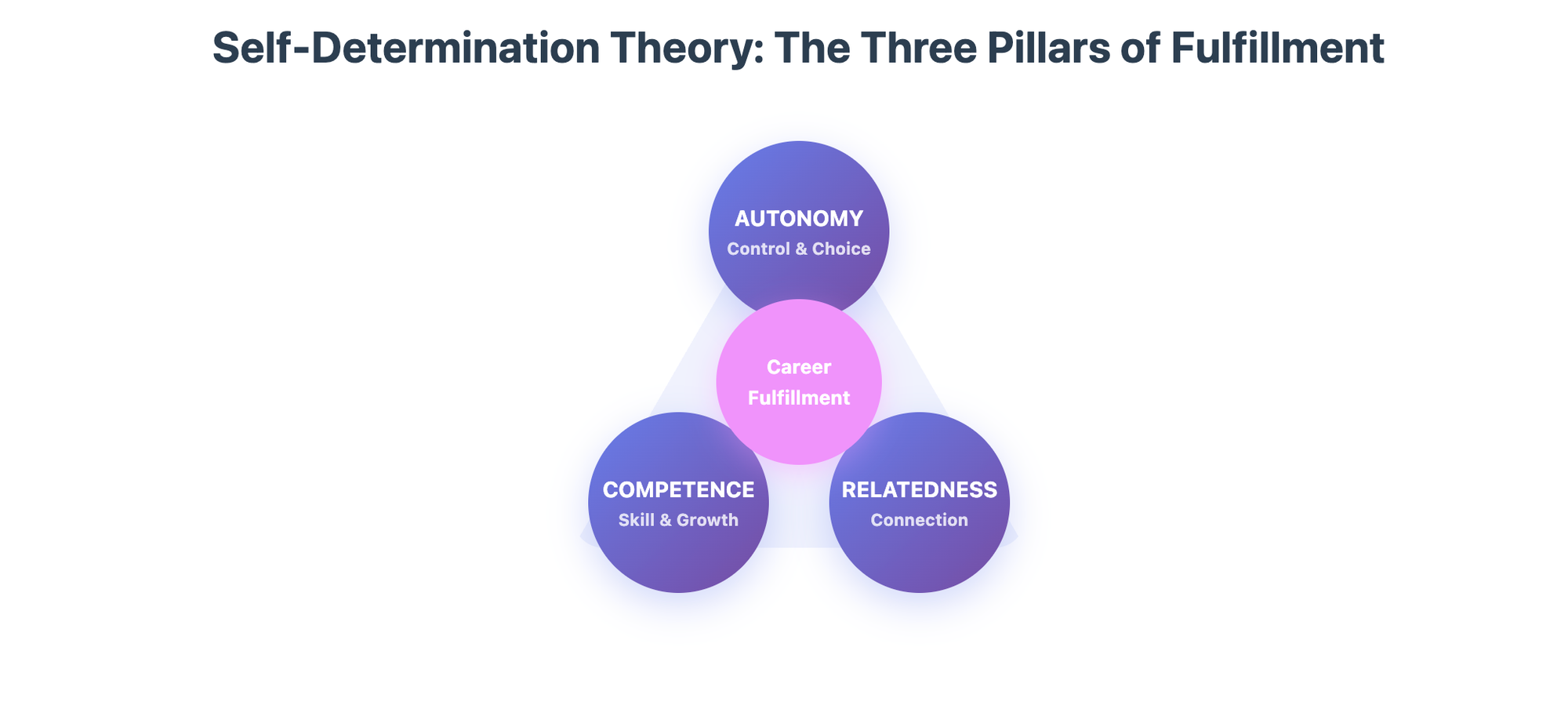
Sustainable career satisfaction doesn't come from external achievements alone. According to Self-Determination Theory⁴, lasting fulfillment arises from satisfying three innate psychological needs: Autonomy (control over your actions), Competence (feeling effective and skilled), and Relatedness (meaningful connection with others).
The Interventions
Maya identified specific ways to boost each psychological need within her existing role:
Autonomy Enhancement: "I asked my manager if I could restructure my schedule to do deep analytical work in the morning when my brain is sharpest, and save meetings for the afternoon. She said yes immediately."
Competence Building: "I started spending 30 minutes every Friday learning a new feature in our analytics platform. It's amazing how much more confident I feel when I'm actively growing my skills."
Relatedness Strengthening: "I began scheduling monthly coffee chats with people from other departments—not for networking, but because I'm genuinely curious about their work. These conversations have become the highlight of my month."
The Cumulative Effect
"I can't believe how different work feels," Maya told me four weeks later. "It's the same job, the same company, the same team. But everything feels more intentional. I feel like I'm actively choosing my experience instead of just enduring it."
Her manager noticed the change too. "She asked me what had shifted because my engagement in meetings was noticeably different. When I explained the experiment, she asked if I'd be willing to share the framework with other team members."
The Transformation: What One Month Actually Changed
"I didn't get a new job," Maya reflected six weeks after completing the experiment. "But I got a completely new relationship with my job. And honestly, that feels more valuable."
The Most Profound Shift
Maya moved from a passive stance ("My career happens to me") to an active stance ("I can consciously shape my career experience"). This psychological shift had immediate practical implications.
"I started seeking out projects that aligned with my blueprint," she explained. "I volunteered for a cross-functional research initiative that perfectly combined data analysis with mentoring junior team members. Six months ago, I would have assumed that opportunity wasn't meant for someone at my level."
The Ongoing Practice
"The framework isn't a one-and-done thing," Maya noted. "I revisit my blueprint every few months to see what's changed. I catch myself when unrealistic expectations start creeping back in. And I'm constantly looking for small ways to boost autonomy, competence, and relatedness in my day-to-day work."
Most importantly, Maya developed what psychologists call psychological flexibility⁵—the ability to adapt, learn, and consciously align actions with evolving values.
"I realized that I'm not a passenger in my career," she said. "I'm the designer. And that changes everything."
The Framework: Your Turn to Experiment
Maya's transformation illustrates the power of applying psychological principles to career design. The beauty of this approach is its scalability—you can implement it over a month, a week, or start with whichever phase resonates most strongly.
Week 1: Create your personal blueprint using self-assessment tools
Week 2: Identify and reframe one unrealistic expectation
Week 3: Make one decision by consciously avoiding a cognitive bias
Week 4: Design three small changes to boost autonomy, competence, or relatedness
The Key Questions to Ask Yourself
- Self-Awareness: "What type of work energizes me versus drains me?"
- Expectation Management: "What unrealistic standard is creating unnecessary pressure?"
- Decision-Making: "Am I choosing this path because it's best, or because I've already started walking it?"
- Daily Design: "How can I create more moments of autonomy, competence, and connection in my current role?"
The Bottom Line
As Maya discovered, you don't need to change jobs to transform your career experience. Often, the most profound shifts come from changing how you think about and approach the work you're already doing.
"The experiment taught me that career design isn't about finding the perfect job," Maya concluded. "It's about becoming the kind of person who can create fulfillment and meaning wherever they are."
Six months later, Maya did end up making a career change—but it was a conscious, strategic move aligned with her blueprint rather than an escape from dissatisfaction. She transitioned to a role that explicitly combined consumer research with team development, using the framework to evaluate opportunities and negotiate role responsibilities.
"The difference," she told me, "is that now I'm moving toward something I've consciously designed rather than running away from something that wasn't working."
📝 Start Your Own Career Design Experiment Maya's transformation proves that you don't need a new job to revolutionize your career experience. Follow her exact 4-week process using this interactive worksheet:
🎯 Career Design Experiment
Follow Maya's 4-Week Framework to Architect Your Professional Happiness
Create Your Self-Blueprint
Week 1: Foundation through Self-Awareness
Select the 2-3 types that most strongly describe you:
The Reality Check
Week 2: Managing Expectations
The Bias Buster
Week 3: Smarter Decision-Making
The Meaning Maker
Week 4: Designing Daily Fulfillment
Want to save your responses or share them for feedback?
Ready to discuss your insights? Email your completed responses for personalized career design feedback.
Send to: seth.looper@gmail.com • I personally review every submission
References
- Holland, J. L. (1997). Making vocational choices: A theory of vocational personalities and work environments (3rd ed.). Psychological Assessment Resources.
- Hayes, S. C., Luoma, J. B., Bond, F. W., Masuda, A., & Lillis, J. (2006). Acceptance and commitment therapy: Model, processes and outcomes. Behaviour Research and Therapy, 44(1), 1-25.
- Kahneman, D. (2011). Thinking, fast and slow. Farrar, Straus and Giroux.
- Deci, E. L., & Ryan, R. M. (2000). The "what" and "why" of goal pursuits: Human needs and the self-determination of behavior. Psychological Inquiry, 11(4), 227-268.
- Kashdan, T. B., & Rottenberg, J. (2010). Psychological flexibility as a fundamental aspect of health. Clinical Psychology Review, 30(7), 865-878.
Note: Names and identifying details have been changed to protect client confidentiality.